Showing posts with label Electroplating. Show all posts

Monday, October 16, 2017

Electroplating Plant

electroplating plant
Electroplating plant is should be arrange in serial work, because each process need different chemicals and from batch to another batch need rinsing in order not contaminated chemicals on the serial batch. Electroplating plant should be designed in semi batch process, can’t run in continuous process, because before and after electroplating process the object need certain treatment. Automatic process is not on the electroplating work but automatic mean every batch is doing by robot, so people just control of every step robot work and the quality of all process, including the quality of chemical solution bath concentration.

Each bath chemical solution is purpose for certain product, for example in producing chromium plating, there are bright chrome plating, black chrome plating , semi dull chrome plating, white chrome plating and any other chrome plated color. Only the preparation of base metal may can have the same process, for rinsing and polishing of each color of chrome plating can be in different method even can use the same equipment. Waste of rinsing and cleaning can be mixed for various chrome plating color, and need further waste treatment process, to make environment friendly.

General order of electroplating process such as follow:
Each of different process which use different chemicals must use different bath but for process which use same solution like just water may can use same bath, it is depend on the plant layout. Each plant can be different layout.

If there are any other electroplating purpose like Nickel plating which use different chemical solution, this need different bath, other wise they must clean the bath every do other kind of plating, and for this can be inefficient work. The plant which apply of many kind of plating can be arrange in serial process and parallel process order.


Saturday, September 23, 2017

Baths for Bright Dipping of Metals

Chemicals Composition For Bath of Certain Metal For Bright Dipping


1. General Steel

  • 25 to 30 g/l oxalic acid plus 10 to 15 g/l 100-volume hydrogen peroxide and 0.08 g/l of sulfuric acid.


2. Copper and Copper Base Alloys

  • 40 to 45% (vol) sulfuric plus 20 to 25 %(vol) of nitric acid and 0.1% (vol) of hydrochloric acid at room temperature.
  • 270 g/l chromic acid at room temperature.
  • 55% phosphoric acid, 20% nitric acid, and 25% acetic acid, all by volume, at 55 to 80oC.

3. Stainless Steel

  • 25% sulfuric acid, 4% hydrochloric acid, and 3% nitric acid, all by volume.


4. Lead

  • 3.5% glacial acetic acid and 3.5% 30-volume hydrogen peroxide by volume.

5. Nickel, Nickel Alloys or Alloy Steel

  • Various combinations of sulfuric acid, phosphoric acid, and nitric acid are used. A typical bath contains 60% phosphoric acid, 20% sulfuric acid, and 20% nitric acid, all by volume. Operates at room temperature.
Last Blog: Chemical and Electrolytic Brightening

Wednesday, January 14, 2015

Electroplating Service in Indonesia

Find Here:


To make your part look more excellent you can try go to electroplating service at some place like in Jakarta or in Bandung or in Surabaya. The price is cheap compare to industrial service, because it can be produce in simple way. They can serve some motorcycle parts, car parts, engine parts and other kind of parts build from metal or from plastic material, basically they can serve metal electroplating or plastic electroplating.

Electroplating on Car Parts

Electroplating on Engine parts

Electroplating on motorcycle parts

Some place you can visit and ask directly to the some electroplating service you can contact to this company:
  1. Jl. Kapuk Raya No. 55 west Jakarta 11720, telp. 021-
  2. Jl. Kelasi No. 19 Surabaya Telp. 031-
  3. Jl. Swadaya kp. Buaran Utara Tambun selatan – Bekasi Telp. 021-
See Electroplating Service:

Tuesday, October 28, 2014

Electroplating Legal Patent

The extension of legal patent of certain patent is no longer needed, is this mean that we are no need permit to use the process of electroplating? May be because of many people in the world already use use this Chromium Electroplating Process without patent anymore or patent payment is not effective anymore. People don't want to pay of that certain patent process so that patent is no longer need to be extended.


Some important point on the patent you can read as bellow, so that you can develop your process in order can optimize of your electroplating process:

A plating process for plating chromium metal onto substrates is disclosed. The process uses a trivalent chromium plating bath with a sulfate and/or sulfonate matrix. The process also utilizes insoluble anodes. An addition of manganese ions to the plating bath inhibits the formation of detrimental hexavalent chromium ions upon use of the plating bath.

The present invention relates to a chromium plating method which utilizes trivalent chromium ions in the plating bath and insoluble anodes. An additive is proposed for the chromium plating bath which will minimize the creation of hexavalent chromium ions at the anode while the plating bath is being used.

The present of hexavalent on electroplating bath often disturb the formation of smooth layer on the metal. With additional of manganese ion like dissolve manganese metal into the sulfuric acid bath can help to prevent on the formation of hexavalent chromium ions.

Saturday, October 25, 2014

Electroplating Process Flow Diagram

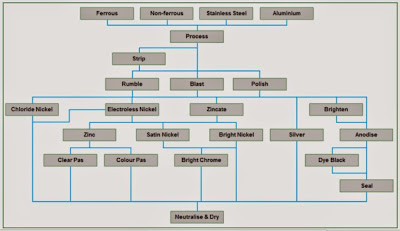
Electroplating Flow Diagram actually already discussed on this blog but still don't make a flow diagram as flow diagram. Flow diagram actually function for people want to know globally but don't want to know each detail process and what the chemical use and what the problem on each process. Flow diagram process usually just explain to the new comer or to the visitor who want to know the whole process of electroplating or of each electroplating process such as; chromium plating, nickel plating, gold plating, silver plating, etc.


The process flow diagram in one plant as follows:

electroplating flow diagram


Flow Diagram Explanation


  • Strip = Removal of old plating or paint
  • Rumble = Bulk processing of medium size parts, from burr removal to preplate or polish finish
  • Blast = Glass grit or bead blast, from scale removal to preplate camera finish
  • Electroless Nickel = Special even coat on stainless steel, and non ferrous material
  • Chloride Nickel = Preplate coat on stainless steel
  • Zincate pre-coat = Coating to enable plating on aluminum and its alloys
  • Brighten = Chemical semi-bright processing prior to Anodize

Wednesday, October 23, 2013

Metal Electroplating

Metal electroplating have been applied over recent decades. Many application on using of electroplating process have been developed for many purposes like enhance the corrosion resistance, or for decorative purposes to make some metal have better appearance.


For other purposes the characteristic of electroplating often use because of electroplating is often also called as electro deposition. Electro deposition is the process of producing a coating, usually metallic, on a surface by the action of electric current. The deposition of a metallic coating onto an object is achieved by putting a negative charge into one electrode cell. The metal ion like salt carry a positive charge and are thus attracted to the object. This method often use on collecting metal from the solution that may be have high concentration. The result like to extract something from mixing solution then we can collect of just metal that dissolve in the solution.

Electroplating uses a form of electrolysis in which the electrodes play a bigger role than just conducting the current. Using electric current we can coat metal of one electrode with the metal of other. Jewelry and silverware can be silver, or gold plated, while zinc is often used to coat iron to protect against rust.

Thursday, February 25, 2010

How does Electroplating Work

Electroplating can work just because of metal dissolved on certain solution. On the solution metal characteristic is different with the original properties that hard and strong. This can similar with magnet work that can pull other metal because of magnetic properties available on that metal. But not all metal have magnetic properties or can be pulled by magnet, many other kind of metal don’t have magnetic properties like aluminum and even stainless steel. Steel itself have magnetic properties but stainless steel don’t have magnetic properties after modified from the original metal and change into stainless steel.

Thursday, January 7, 2010

Electroplating Experiment

Try one Experiment:


To do an experiment of electroplating really for fun, because we can see the result directly and feel amazing after see the chemical reaction effect of electroplating or the result of experiment. To see the result of electroplating experiment actually just need a few second, but to prepare this experiment we need long time. Include in preparing the chemicals and preparing the electroplating tools. This preparation sometime eat time, and if we don't know the source or less of knowledge will get a bad result. I just suggested before you do an experiment, beside you need enough theoretical material, you should know the practice of electroplating from the practitioner that already do this. Sometime they just use a simple tools for doing an electroplating process but with a good result, so you better learn from them. They sometime serve openly to electroplate the metal from their customers, and you can learn and see the real practice.

Monday, June 29, 2009

Electroplating of Other Metals

Magnesium and aluminum cannot be format as coatings by electroplating from aqueous solutions as they are too basic. Most other metals in common use can be electroplated, but their industrial demand is limited except for the metals already mentioned.

Lead is sometimes plated onto chemical plant or for special purpose bearings. Indium is plated onto the lead bearings. A fluoborate solution is used in both cases. Platimun and Palladium coating are sometimes used for jewellery and for electrical instruments, but of the platinum metals, rhodium is the most utilized as a thin (1 mg/cm2) tarnish preventing coating on silver and in thicker layers for electronic switching devices.

Last Electroplating Type:
Thin Plating
Zinc and Cadmium Electroplating
Copper Plating
Gilding or Gold Plating
Silver Plating

Wednesday, May 27, 2009

Zinc and Cadmium Electroplating

Many Kind of Zinc Electroplating:


Zinc and cadmium are also plated from double cyanide baths. There is less difficulty in dissolving the anodes and it assists if the solution is alkaline, so that caustic soda is often added, or formed automatically by using the metal oxide and more cyanide. The purpose for which these metals are electroplated is almost always to protect iron and steel from rust. They are not usually polished because appearance is secondary. Although zinc is a fairly reactive metal it soon covers itself with a protective film under neutral conditions, so that it is fairly resistant to the weather and to waters. Moreover, by the sacrificial action previously explained it protects the underlying steel even where the deposit is porous or damaged. However, this necessitates a thicker coating to allow for this sacrificial action.

The potential difference between steel and cadmium at exposed points is small but, especially in slightly alkaline solutions, cadmium protects steel by a slight sacrificial action, but it is not so readily corroded as zinc and the corrosion products are less unslightly. Cadmium is more resistant than zinc to weakly acid solution and is more effective with weakly alkaline solutions such as those used for household washing. But cadmium is very expensive and becoming more so; therefore, although it is preferred form many purpose, particularly for aircraft parts, it is only used where the better service offset its greater cost. Both zinc and cadmium compounds are somewhat toxic, electroplates of these metals should not be used on articles for use with foodstuff.

Both zinc and cadmium can be electroplated in a lustrous condition by means of brightening additions. Alternatively the matt deposits from the simple solution can be chemically brightened after completion of the plating by immersion into simple chemical dips. A dip can also be used to preserve a zinc deposit from the superficial but disfiguring “white rust” a whitish protective film which zinc soon acquired in the atmosphere. A typical passivating dip is an acid solution of sodium dichromate.

Zinc coating can also be electroplated on geometrically simple articles, such as sheet and wire, from an acid zinc sulfate solution. This is practice on a large scale by the manufacturers of such semi fabricated commodities, where the hot dipping process is impractical.

Sample of Electroplating:


Thursday, April 2, 2009

Electroplating of Silver, Gold, Copper, Zinc and Cadmium

Coating Metal for Electroplating Process


You can plating metal surface using Silver, Gold, Copper, Zinc or Cadmium. Those materials are chosen because of their characteristic of stand to corrode. It is convenient to deal with the electroplating of all the above metals together, because the same type of solution is used in each case, viz, the double cyanide solution. Cyanides are the salts of the very weak hydrocyanic acid (prussic acid). The cyanides of sodium and potassium are soluble in water, but the cyanides of the heavy metals are insoluble; nevertheless these insoluble cyanides readily dissolve in a solution of sodium of potassium cyanide to form a double salt.

NaCN + AgCN → NaAg(CN)2 ↔ Na+ + Ag(CN)2-

This double salt dissociates in solution to yield sodium ions and a negatively charged double cyanide ion which contains the heavy metal. Although most of the heavy metal is bound up in the anion and not available for plating, this double cyanide ion further dissociates to be in equilibrium with a very small amount of positively charged heavy metal ion, which are available for plating.


As they are used up by deposition, more are immediately provided by further dissociation of the double cyanide anion. The advantages of this type of electroplating solution over solutions of simple salts of the metal concerned are twofold; firstly, the deposit is of much finer grain size, and hence is smoother and more reactive metal, when this is first placed into the plating solution.
See more about

Thursday, March 26, 2009

Zincate Plating Process

Racking
Racks should have type 304 or 430 stainless steel or phosphor bronze tips and be coated with vinyl plastisol. Good plating practice requires good rack maintenance. Rack tips should be kept free of electroplated buildup and damaged plastisol should be repaired.

Cleaning
Usually soak cleaning and cathode cleaning in alkaline solution are required.

Activation
The solution is used to remove any residual chromate from the pickling acid and to produce an oxide free surface. A typical composition is:


Phosphoric acid, H3PO4, 85% 20% (v0l) 200 ml
Ammonium acid Flouride, NH4HF2 90 g/l
Temperature 16 – 30oC
Time 1 to 2 min

Zincate Solution
Zinc Sulfate, monhydrate, Zn SO4 . H2O 30 g/l
Tetrasodium pyrophosphate, Na4P2O7 120 g/l
Lithium Flouride, LiF, or 3,75 g/l
Sodium Flouride, NaF 5 g/l
Sodium Carbonate, Na2CO3 5 g/l
pH (electrometric) at 24oC 10.2 to 10.4
Temperature 60 – 76oC
Time 3 to 10 minute

Agitation, work movement or solution agitation
Equipment – type 316 stainless steel tank and heater or a rubber tank and Teflon heater.

Other articles:

Thursday, March 19, 2009

Electroplating on Magnesium and Magnesium Alloys

Electroplating Use Other Base Metal


Several kind of metals can be plated with other good character metal like chrome, nickel, silver, copper or gold. But each metal should use different solution in order can get good plating on them. To see what kind of Chemicals for each base metal see on this link Chemical composition of using certain metal.

Metals are plated on magnesium for solderability; r.f grounding, hermatic sealing, wear resistance, corrosion protection, appearance, electrical conductivity, and for control of radiation by absorption and emission. Magnesium is electronegative and highly reactive to wet aerated and chloride-containing environments which cause the rapid formation of an alkaline surface film. As a result of this property, magnesium cannot be plated with conventional preplate procedure.

Two preplate methods for magnesium have been proved in production. These are the zinc immersion (zincates) process and direct plating without a zinc immersion coating by utilizing fluoride in the plating solution. The mechanism of the latter method is based on the inhibiting action of fluoride on the magnesium. This technique works particularly well for the application of electroless nickel directly on magnesium.

The most widely used preplate process for magnesium wrought and cast alloy is zincates. The essential steps in the process are cleaning, pickling, activation and initial copper strike plating solution. The detail of electroplating using zincates will discussed more detail further..

Other articles:

Monday, February 16, 2009

Electrolytic Brightening of Metal

A radically different chemical immersion brightening process is available for super purity aluminum and its magnesium alloys, under the name of the Erftwerk process. This utilized a solution of nitric acid and ammonium biflouride. A minute trace of lead is also essential to the process. The solution is operated at about 60oC in hard rubber or PVC tanks. The reaction is extremely vigorous, but the fumes are less unpleasant than with phosbrite; 1 to 2 m immersion only is necessary. The product of the reaction is aluminum fluoride, which precipitates, so that although the solution becomes exhausted it can be continuously regenerated by addition of ammonium bifluoride and occasionally of nitric acid. The process is therefore fairly cheap to operate, and has been widely used in Germany as a component part of the process of producing bright anodized motor can trim parts.


In these chemical brightening processes the driving force is provided by the chemical energy from the dissolution of the metal in the acid. In electrolytic brightening the driving energy is supplied by an external current. The work piece are made the anode, i.e. they are connected to the positive side of the current source. This has the advantage, compared with chemical brightening, of being more controllable, and dealing with metals which do not dissolve vigorously in acids, but the disadvantage of requiring more plant (current source, meters, hangers, etc.) and particularly of a varying action on outstanding and re-entrant areas. Comparatively high current densities have to be used, often over 200 A/ft2.

Electrolytic brightening has achieved considerable industrial importance for stainless steel (usually for the austentic nickel chromium 18:8 alloy) which is a hard and difficult metal to polish mechanically. Sulfuric phosphoric acid mixture are used, sometimes with the addition of glycerine or chromic acid. Somewhat similar solutions are also used successfully in industry for aluminum alloys. An alkaline electro brightening process for super purity and high purity aluminum alloys (the Brytal process) utilized a hot alkaline solution of sodium phosphate and sodium carbonate at a modernate current density of about 10 A/ft2.

Other articles:

Sunday, February 8, 2009

Semi Automatic Plating

Semi Batch Plating Process


Experience has shown that chrome plating can be satisfactorily achieved from chromic acid solutions of any concentration provided than an amount of sulfuric acid (or equivalent sulfate) is present equivalent to about one hundredth part of the of chromic acid concentration. Beyond the limits of about 50:1 and 200:1 the solution just will not work at all. Hydrofluoric acid or flourosilicic acid can be substituted for sulfuric acid, but with no particular advantage.

Chromic acid is in fact difficult to isolate as a single chemical substance, although it undoubtedly exists in aqueous solution. The substance commercially sold as chromic acid is the anhydride (CrO3), i.e. chromic acid less water.

CrO3 + H2O → H2CrO4 ←→ 2 H+ + CrO4-

The unexpected type of composition is not the only unusual feature of chromium plating. Unless the current density exceeds a substantial figure (60 to 80 A/ft2), no electroplate whatever is obtained. Even above this minimum the electroplating process is grossly inefficient, i.e. only a mino, proportion of the current density is employed usefully in depositing chromium; the remainder uselessly generates hydrogen gas. Thus very high current densities need to be used and even then the rate of growth of the deposit is very slow, at 200 A/ft2 it is only 0,0005 in/h. Furthermore the appearance and mechanical properties of the electroplate are very sharply and critically dependent on the temperature of the solution.

Below the temperature 45oC the deposit is dark grey, rather hard and brittle, and is considered industrially useless, between 45 and 55oC it is lustrous and bright, glass-hard, intensely brittle and microscopically cracked; above 55oC it is milky lustrous and unsatisfactory. Finally the solution cannot be operated satisfactorily with chromium metal anodes, even if sufficiently pure metal were available, which it is not. The bath has therefore to be run with ‘insoluble’ anodes of lead or of lead-antimony alloy. These soon become coated with an electrically conducting film of lead peroxide, at which the current generates oxygen gas. The oxidizing conditions at the anode maintain the chromic acid in the oxidized state. The mechanism of chromium plating will not be discussed here, except to say that it is exceedingly complex and to some extent not yet fully elucidated.

Wednesday, July 23, 2008

Avoid Polarization

To avoid excessive polarization at any anode in the copper sulfate bath, the anode current density should not be more than about 5 A/dm2 in un-agitated baths. With vigorous air agitation, the limiting anode current density is more than 17 A/dm2. The anode current density in an agitated fluoborate bath can be as high as 40 A/dm, and with air agitation, it can be increased to 55 A/dm2

Small amount of silver, sulfur, lead, tin, nickel, and other elements are common impurities in rolled, cast and electrolytic copper. Silver as impurities in the anodes employed in sulfate and fluoborate baths is of much less consequence than it is cyanide bath. OFCHC and electrolytic copper were found to have lower impurity content than rolled or ordinary cast anodes. The metallic impurities in OFHC and electrolytic copper totaled about 0.006%.

Grain size is considered inconsequential. Two batches of high purity anodes with average grain sizes of 10 and 0.01 mm performed similarly. On the other hand, high density is a desirable characteristic, because it promotes uniform anode dissolution.

An instance is reported of a preference fro continuously using insoluble, conforming anodes in order to improve deposit thickness distribution. Copper was replenished by circulating the solution through an auxiliary electrolytic tank connected in series with the electroforming tanks. The electrolytic corrosion tank was equipped with soluble copper anodes and scrap. On each side of a rotating disk cathode efficiency low. The insoluble anodes in the electroforming tanks were made with silver lead alloy (1% silver).

Lead containing 3% tin and 3% antimony has been proposed as an insoluble anode for facilitating the plating of printing rolls.

An insoluble of copper, silicon, iron, and lead. Graphite is the only electrically conductive material known to be insoluble as an anode in the fluoborate bats. When used as an anode, graphite produces a sludge of finely divided carbon particles.